
CloseHomeApplicationsComparisonNewsContact

Application Overview

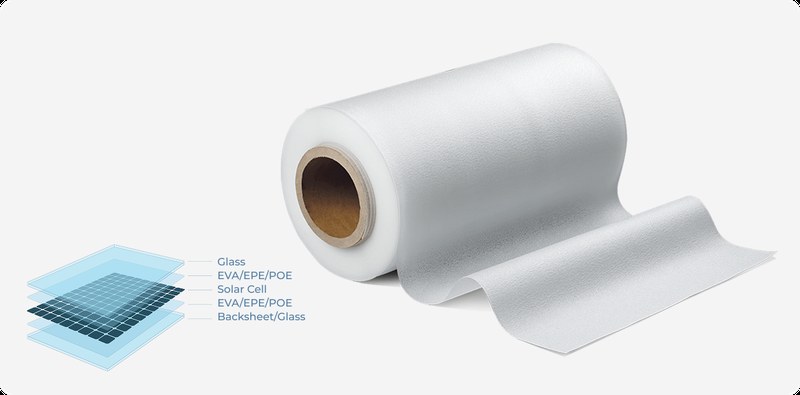
EVA encapsulant film is placed above and below a connected cell string before the module is heated and pressed. As it crosslinks, the film bonds the cells to the glass and backsheet and locks the string in place.

A good encapsulant wets the cell surfaces, fills the small gaps around interconnects and keeps the optical path clear. That combination protects the circuit while preserving light reaching the active area.

How EVA Works

The same four functions apply wherever EVA encapsulant is used.

  • Optical Coupling

    The refractive index of cured EVA is close to that of module glass, which reduces reflection at the cell surface and lets more light reach the junction.

  • Mechanical Bonding

    Crosslinked film adheres to glass, cells and backsheet, so the laminate behaves as one solid sheet rather than a stack of loose layers.

  • Moisture Sealing

    The cured encapsulant limits water vapour and oxygen reaching the cell surface, slowing corrosion of contacts and interconnects.

  • Electrical Insulation

    EVA is an electrical insulator; it separates the conductive circuit from the module edges and outer surfaces.

What Sets It Apart

Our encapsulation film is focused on predictable lay-up and cure. The film softens and flows in a controlled way during the heated stage, then crosslinks to a stable gel. Module builders can hold gel content at or above 75% and light transmission at or above 91% when the lamination cycle is kept around 140–150 °C.

Consistent gauge and clean surfaces reduce voids around cell edges and interconnect ribs, which is where encapsulation defects usually begin.

Processing Guidance

1

Prepare the Lay-Up

Keep film rolls sealed until use, bring them to room temperature, then cut to the glass size and position the sheets over and under the cell string.

2

Laminate

Apply vacuum and pressure while heating to about 140–150 °C so the film flows, wets the cells and crosslinks into a single laminate.

3

Cool and Inspect

Hold pressure during cooling, then check the laminate for voids, edge seal and clear optical appearance before framing.

Where It Is Used

Common module formats and working conditions for this application.

  • Flat-Plate PV Modules

    Standard glass, cell and backsheet stacks where EVA provides structural bonding and edge sealing.

  • Bifacial Constructions

    Lay-ups that need stable optical behaviour on both sides of the cell string.

  • Outdoor Installations

    Modules exposed to humidity and temperature cycling where moisture sealing is critical.

Packaging and Delivery

How the film is protected and identified before it reaches your line.

  • Wound Rolls

    Film is supplied wound on cores with a release layer, ready for automated or manual cutting.

  • Moisture Protection

    Rolls are kept in moisture-barrier packing and should stay sealed until the lay-up stage.

  • Batch Traceability

    Each production run is identified so film performance can be followed back to its manufacturing batch.

Related Applications

Explore the other ways EVA encapsulant is used in module assembly.

Start a Conversation

Scan to chat with Julie Gong on WhatsApp.