
CloseHomeApplicationsComparisonNewsContact

Application Overview

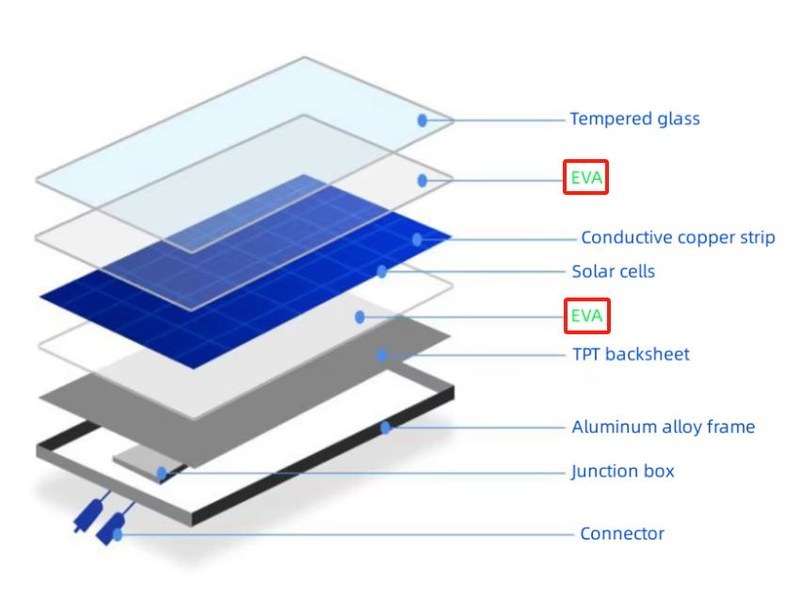
Lamination is the step that turns a laid-up stack of glass, cells and backsheet into a weather-tight panel. EVA film is the bonding and sealing medium in that step.

During the hot press stage the film flows around the cells, expels air under vacuum and then sets by crosslinking. The result is a laminate that resists moisture ingress and mechanical stress.

How EVA Works

The same four functions apply wherever EVA encapsulant is used.

  • Optical Coupling

    The refractive index of cured EVA is close to that of module glass, which reduces reflection at the cell surface and lets more light reach the junction.

  • Mechanical Bonding

    Crosslinked film adheres to glass, cells and backsheet, so the laminate behaves as one solid sheet rather than a stack of loose layers.

  • Moisture Sealing

    The cured encapsulant limits water vapour and oxygen reaching the cell surface, slowing corrosion of contacts and interconnects.

  • Electrical Insulation

    EVA is an electrical insulator; it separates the conductive circuit from the module edges and outer surfaces.

Bond Integrity

The lamination window matters more than speed. Our film is designed to stay workable long enough for air to leave the stack, then build adhesion to both glass and common backsheets. Gel content at or above 75% after a 140–150 °C cycle is a useful check that the cure has developed.

Because the same film bonds unlike surfaces, it also absorbs the difference in thermal expansion between glass and polymer layers, reducing stress at the cell edges.

Processing Guidance

1

Stack and Vacuum

Lay glass, film, cell matrix, film and backsheet in order, then draw vacuum to remove trapped air.

2

Hot Press

Press at about 140–150 °C for the designed dwell so the film flows and crosslinks evenly across the panel.

3

Cool Under Pressure

Keep the laminate under pressure while it cools, then trim and frame once the encapsulant has set.

Where It Is Used

Common module formats and working conditions for this application.

  • Module Assembly Lines

    Continuous or batch lamination where repeatable cycle times are required.

  • Rooftop and Utility Panels

    Panels that must tolerate long-term outdoor humidity and daily thermal cycling.

  • Glass-Glass Designs

    Symmetric stacks where EVA bonds two glass sheets around the cell layer.

Packaging and Delivery

How the film is protected and identified before it reaches your line.

  • Cut-to-Size Film

    Sheets can be supplied pre-cut to common panel formats to simplify the lay-up station.

  • Sealed Packing

    Protective packaging limits moisture pickup between production and lamination.

  • Lot Identification

    Every roll or sheet batch carries an identifier for quality review.

Related Applications

Explore the other ways EVA encapsulant is used in module assembly.

Start a Conversation

Scan to chat with Julie Gong on WhatsApp.